
How Many Calories Should I Eat a Day to Lose Weight? A Nutritionist’s Practical Guide
If you search online for your daily calorie needs, you will get twenty different answers. One app tells you to eat 1,200 calories immediately. A fitness forum tells you that anything under 2,200 ruins your metabolism.
Here is the honest truth from my years in nutrition: there is no single magic number that fits everyone. A 5-foot-2 office worker does not burn energy at the same rate as a 5-foot-10 mother chasing toddlers and lifting weights three times a week.
Learning how many calories should I eat a day does not require complicated math or panic. It simply takes understanding your baseline burn and setting a moderate, comfortable deficit that lets you eat real food every day. Below, I break down the exact formula I use with my clients, provide a reference chart by body size and activity, and explain how to pick a plan that fits your life without starvation.
Find Your Calorie Target & Get the Free PDF Plan
Get our printable calorie formula sheet, deficit comparison guide, and weekly meal plan delivered straight to your inbox.
The 3 Numbers That Decide Your Calorie Target
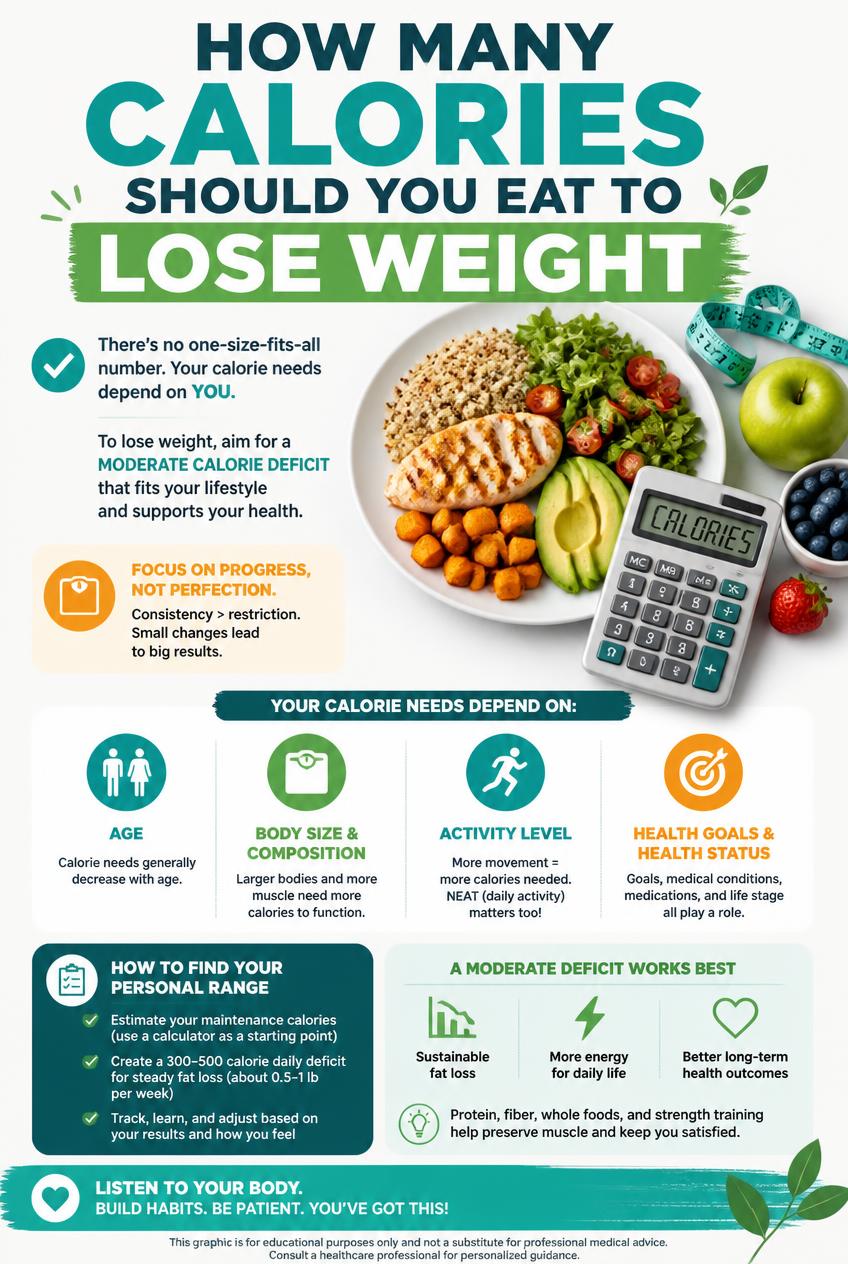
Your body expends energy all day long, even when you are asleep. To find your weight loss intake, we look at three factors:
- Basal Metabolic Rate (BMR): The baseline energy required to keep your heart pumping, lungs breathing, and cells regenerating at rest. For most adults, this makes up 60% to 70% of total daily burn.
- Non-Exercise Activity (NEAT): The energy burned during everyday movement: walking around the house, folding laundry, typing, and taking the stairs. This varies hugely between people.
- Exercise & Food Digestion (TEF): The fuel burned during gym workouts and the energy required to break down food (especially lean protein).
Together, these three create your Total Daily Energy Expenditure (TDEE). That is your maintenance level: the exact calories where your body weight stays unchanged.
→ Launch the Free Calorie Calculator
Once the calculator gives your number, simply match it with our complete 7-day printable plans below:
- 1,200 Calorie Plan (for petite or less active adults)
- 1,400 Calorie Plan (light step-down)
- 1,500 Calorie Plan (the balanced sweet spot for most)
- 1,800 Calorie Plan (active or taller individuals)
- 2,000 Calorie Plan (higher physical activity demands)
How Big Should Your Deficit Be?
When people decide to lose weight, their natural impulse is to cut as much food as possible. “If cutting 500 calories works, cutting 1,000 must be twice as good!”
That is where diets fail.
An aggressive deficit triggers severe counter-reactions: your body lowers thyroid production slightly, you feel sluggish and stop moving throughout the day, and intense food cravings arrive by Thursday night.
Here is the standard guideline I give my clients:
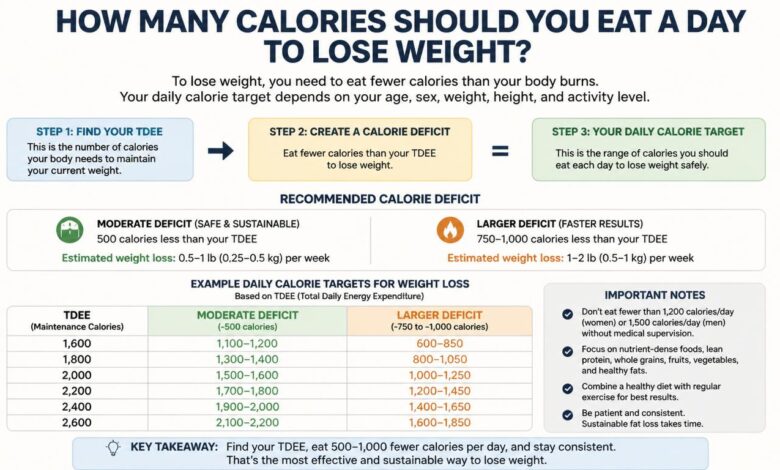
- Small Deficit (250–300 calories below maintenance): Produces around 0.5 pounds of fat loss per week. Gentle, completely painless, and great for people who love eating larger meals or train hard.
- Moderate Deficit (400–500 calories below maintenance): Produces roughly 1 pound of fat loss per week. This is the gold standard for steady, predictable progress without muscle loss.
- Aggressive Deficit (600–750 calories below maintenance): Only recommended for individuals with higher starting body weights, under proper supervision. Should not be run long-term.
Estimated Daily Targets at a Glance
Here is a general benchmark of where average adult women and men land for moderate weight loss (aiming for roughly a 500-calorie deficit from maintenance):
| Profile | Activity Level | Estimated Maintenance | Target Weight Loss Intake |
|---|---|---|---|
| Smaller Female (5’1″ – 5’4″) | Sedentary (desk job, low steps) | ~1,600 – 1,750 kcal | 1,200 – 1,300 kcal |
| Average Female (5’4″ – 5’7″) | Lightly active (6k-8k steps, 2 workouts) | ~1,900 – 2,100 kcal | 1,400 – 1,550 kcal |
| Active Female or Average Male | Moderately active (gym 3-4x, 10k steps) | ~2,200 – 2,400 kcal | 1,700 – 1,850 kcal |
| Tall / Very Active Male | Heavy lifting, physical job, sports | ~2,600 – 2,900 kcal | 2,000 – 2,200 kcal |
*Values are general estimations based on Harris-Benedict formulas. Use our calculator for personal calculations.
Amelia’s 3 Rules When Setting Your Number
Before you lock in your daily target, keep these three practical rules in mind:
- Never Start at the Absolute Minimum: If you maintain at 2,000 calories, do not drop straight to 1,200. Start at 1,500. Give yourself room to eat as much food as possible while still losing fat. You can always adjust later.
- Track Protein as Closely as Calories: If your target is 1,500 calories, make sure 100 to 130 grams come from protein. Protein protects your muscle mass, keeps you full, and raises the thermic effect of food. Review our guide on high protein meals for simple ideas.
- Watch the 3-Week Trend, Not Daily Fluctuation: Water weight shifts up and down constantly due to sodium, hormones, and muscle soreness from the gym. Weigh yourself once or twice a week and judge progress by the three-week trend, not a single morning.
Get Your Personal 7-Day Meal Plan PDF
Choose your calorie level and download the free printable menu with full recipes and shopping list.
What Should Those Calories Look Like on Your Plate?
A calorie deficit tells you how much energy to consume. But the quality of the food dictates how full you feel.
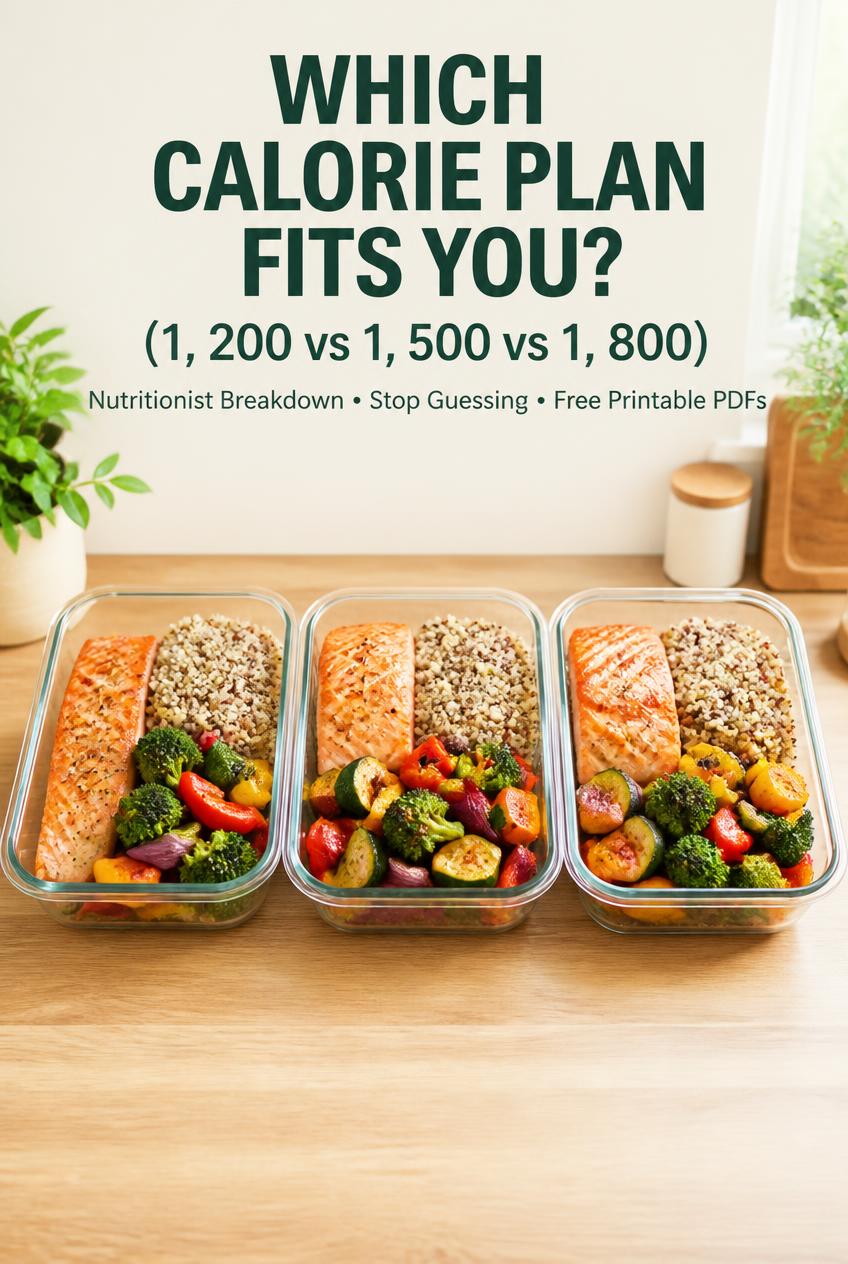
If you spend 1,500 calories on fast food and sweetened drinks, you will feel ravenous and exhausted by mid-afternoon. But when you build those 1,500 calories from whole foods, you get three substantial meals and two snacks:
- Lean Proteins (30–35% of calories): Chicken breast, cod, salmon, lean beef, eggs, Greek yogurt, and cottage cheese.
- High Volume Produce: Zucchini, broccoli, spinach, cucumbers, and berries take up physical stomach space for minimal calories. See our complete list of high volume low calorie foods.
- Slow-Burning Fibers: Rolled oats, brown rice, sweet potatoes, and black beans provide sustained energy throughout your day.
Amelia’s Final Word: Your Calorie Target Is a Guide, Not a Prison
Do not let calorie counting turn into an obsession. Think of your number as a helpful boundary, like a monthly budget. If you go over by 100 calories on Tuesday because you enjoyed dinner with friends, you have not ruined your progress.
Pick a target that leaves you feeling energized, fuel your gym workouts, eat plenty of real food from normal grocery stores, and stay consistent over months. Steady progress always wins.
Give your body respect, eat real meals, and let consistency do the heavy lifting.
Frequently Asked Questions
Can I eat fewer than 1,200 calories to lose weight faster?
Eating below 1,200 calories per day without direct physician supervision is strongly discouraged. Extremely low-calorie diets increase the risk of nutrient deficiencies, muscle wasting, gallstones, and metabolic slowdown. Sustainability is far more effective than extreme restriction.
What should I do if my weight loss stops?
As your body weight drops, your daily maintenance calorie requirement naturally decreases. If your weight has stayed unchanged for three full weeks, check for untracked cooking oils or drinks, or gently lower your daily target by 100 to 150 calories.
Do I need to eat the exact same calories every day?
Not necessarily. Some people prefer calorie cycling: eating 150 calories less on sedentary workdays and 150 calories more on intense workout or weekend days. What matters for fat loss is your total weekly energy deficit.

Written by Amelia
Nutritionist & Gym EnthusiastAt 38, I balance gym training with developing practical nutrition guides for everyday life. I focus on moderate energy deficits, wholesome supermarket ingredients, and sustainable habits that protect long-term metabolic health.
Get Your Free 7-Day Meal Plan PDF
Choose your calorie target and receive the printable weekly plan with portion guides and full grocery lists straight to your inbox.